Why 50% and 50% Is Not 100% in VA Math
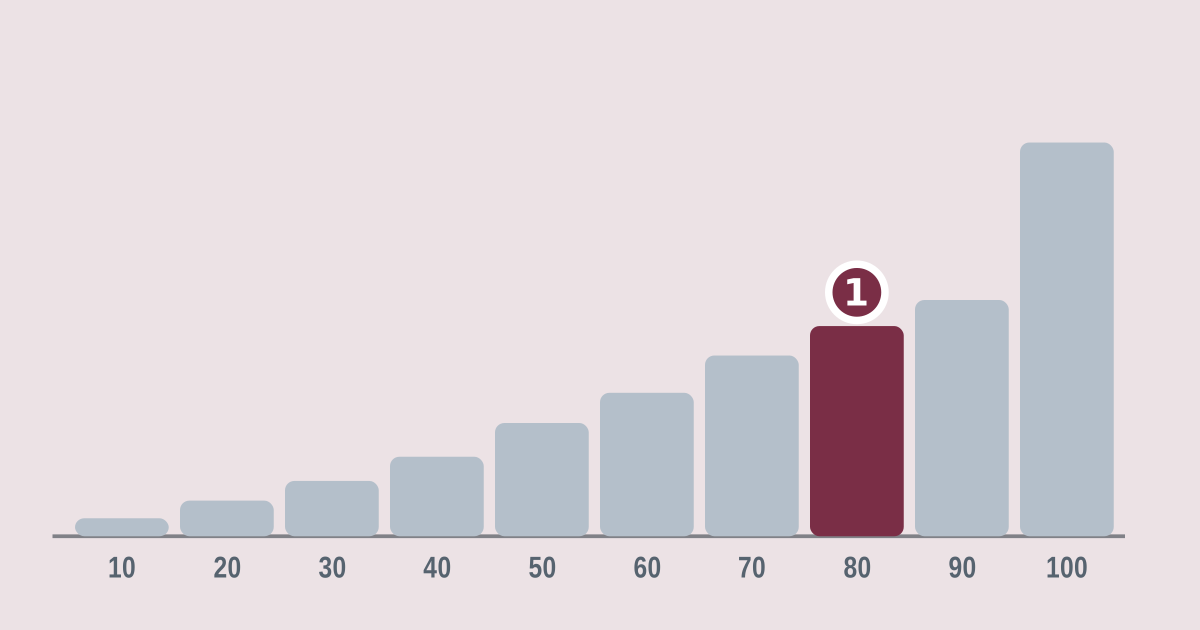
In VA math, 50% and 50% make 75%, rounded to 80%, not 100%. VA does not add ratings. Under 38 CFR 4.25 each disability takes its percentage of whatever ability is left after the ratings before it.
- 150% rating 50 squares
- 250% rating 25 squares
- 3Efficiency left 25%
- 4Combined 80%
The efficiency idea
The regulation starts from a person who is 100% efficient. Its own example: someone 60% disabled is 40% efficient. A further 30% disability takes 30% of the 40 that is left, leaving 28% efficiency, so the person is rated as 72% disabled. Each new rating has less to work on, which is why the total can approach 100 but adding never gets there.
Table I, the combined ratings table, prints the result of that arithmetic for every pair. Its rows run from 19 to 94 and its columns from 10 to 90. Every cell equals the row value plus the column's share of what remains, rounded to a whole number.
The published examples
- 50 and 30 percent: Table I gives 65, converted to 70 percent.
- 40 and 20 percent: Table I gives 52, converted to 50 percent.
- 60, 40 and 20 percent: 60 and 40 give 76; 76 and 20 give 81, converted to 80 percent.
- VA's ratings page: two 10% disabilities combine to 19%. With a third 10%, VA's example goes 50 and 30 to 65, then 65 and 10 to 69, rounded to 70%.
The calculator reproduces each of these, and its tests check them on every build.
Order, then rounding once
Ratings are put in order of severity and combined two at a time, the result of each step becoming the row for the next. The value found is carried forward exactly. Only at the end is it converted to the nearest 10, and values ending in 5 go up. The regulation says rounding "rounding will be done only once per rating decision".
That single rounding matters. Take 50, 30 and 10: the steps are 65 then 69, rated 70%. If the 65 were rounded to 70 first, the 10 would then give 73 and the answer would still be 70, but in other cases early rounding changes the result, which is why the rule forbids it.
Small ratings can vanish, then come back
A rating can add points to the exact value without changing the rounded rating. 40% and 20% make 52, rated 50%, the same as 40% plus nothing above the fives. But the 20% is not lost: a later 10% combines with 52, not 40, giving 57 and a rating of 60%.
Where to go next
The combined ratings table shows every pair from 10% to 90%, and the pay by rating pages show what each result is worth. When both legs or both arms are rated, the bilateral factor adds a further step.
Sources
- eCFR, 38 CFR 4.25 Combined ratings table, checked 2026-10-20.
- VA, About VA disability ratings, checked 2026-10-20.
Questions
What is 50% and 50% in VA math?
75%, which rounds up to 80%. The second 50% applies to the half of the person the first rating left, so it adds 25 points, not 50.
Does VA round after every step?
No. 38 CFR 4.25 carries each Table I value forward exactly and converts only the final value to the nearest 10, with values ending in 5 going up.
Can combined ratings ever reach 100%?
Yes, when the final Table I value is 95 or more, because 95 rounds up to 100. 90% and 50% make 95, which rounds to 100; 80% and 70% make 94, which rounds down to 90.